
Skip to content
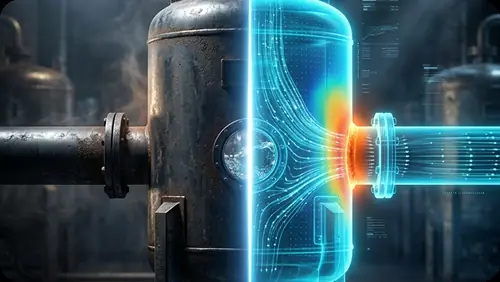
A physics model of an industrial furnace

What‑if Lab · digital twins you can question

Ask “what happens if…” in plain English. Get a range checked against the physics of your machine.

Three questions plants ask every week — “what if we raise the reflux ratio?”, “what if we run the furnace 6 % lower?”, “what if we stretch the cleaning interval?” — answered as a range with a confidence, not a guess. A digital twin, without the six‑month twin project.

one what‑if, start to finish

A steel mill asks about its furnace

Six steps from the question to a checked answer. Numbers are a worked scenario. illustrative

QuestionCurrent stateWhat‑ifAnswer as a rangeCheckHand‑off
  1. step 1

    The question

    “Can we cut the electrode power profile to save energy without losing melt rate — and does it help refractory life?”

  2. step 2

    Current state, from live readings

    Electrode power 42 MW · steel bath 1,623 °C · refractory lining 87 mm (≈ 62 % life) · specific energy 410 kWh/t.

  3. step 3

    The what‑if, run against the physics of the furnace

    Power profile −6 % in the flat‑bath phase; arc‑length control tightened. Heat balance, refractory thermal load and melt‑rate models re‑solved together.

  4. step 4

    The answer — a range, not a point

    Specific energy 388–396 kWh/t (−3.5 to −5.4 %) · melt rate −0.4 to −1.1 % · refractory hot‑face load −7 to −9 % → lining life +3 to +5 weeks. Confidence 84 %.

  5. step 5

    The check

    No constraint violated: bath temperature stays in the tapping window; electrode current within limits. If the physics model had disagreed with the statistics, the answer would have said so.

  6. step 6

    The hand‑off

    For a capital decision (new electrode regulator), the Specialists Lab runs baseline vs intervention as a controlled experiment with statistics and provenance.

the answer, drawn

A range inside the physics limits — never a confident-sounding point

The furnace answer above as a picture: where the plant runs today, the answered range, and the constraint window the physics enforces.

Specific energykWh / tPHYSICS LIMITS388–396 · the answer410 · todayMelt rate−0.4 to −1.1 %Refractory hot‑face load−7 to −9 %Lining life+3 to +5 weeksconfidence 84 % · constraint check passed · if physics and statistics disagree, the range widens — or the answer is refused
An answer is a range inside the physics limits — never a single confident-sounding point. (Illustrative: the furnace walkthrough above.)

swipe → to see the whole diagram

Product screen: what-if sensitivity analysis showing which variables help or hurt equipment health, with the physics–model agreement
The same idea on the product: sensitivity per scenario, physics agreement beside it · Screenshot from the product — demonstration data.
before the demo

Get a feel for your own numbers — in your browser

your file · your browser · arithmetic only

Bring a CSV. Nothing is uploaded.

This reads a sensor export on your own machine and computes plain statistics and a straight‑line rate on the column you choose. It is not the platform’s what‑if — no physics, no model — just a feel for your own numbers before a demo.

Pick a file with a header row and at least one numeric column. Your file never leaves this tab.

A pipe cutaway with its heat and flow physics overlaid
how it’s checked

Statistics propose; physics disposes

Every what‑if answer is solved twice: once from what your data says, once from the governing equations of the equipment — heat balance, thermodynamics, kinetics, fatigue. If they disagree, the answer says so and widens the range.

An answer that would violate a physical constraint is not softened; it is rejected and explained.

Physics and standards checks, in depth →
where it applies

Eight kinds of equipment it already knows how to question

Steel mill

arc‑furnace power profile vs energy and refractory life

Distillation

reflux ratio vs purity, duty and flooding margin

Membrane systems

flux vs fouling rate and cleaning interval

Bioreactors

feed and DO set‑points vs titre and batch time

Grinding circuits

mill speed and charge vs throughput and liner wear

Boiler systems

excess air and soot‑blowing vs efficiency and tube life

Rotary kilns

feed rate and burner vs clinker quality and brick life

Paint booths

airflow and temperature vs film build and rework

Three depths of “what if”.

Quick What‑if inside Ryekronix ranks set‑point moves in seconds — a fast estimate. The What‑if Lab solves the physics — a checked range. The Specialists Lab runs a controlled experiment — statistics and provenance.

Same question, three depths; you choose by the stakes.

questions engineers ask

Four answers

Do we need to build a digital twin first?
No. The What‑if Lab solves your question against the governing physics of the equipment class — heat balance, thermodynamics, kinetics, fatigue — using your live readings as the starting state. You get twin‑grade answers without a six‑month twin project.
Why is a range better than a single number?
A single number hides how sure the answer is. A range with a stated confidence tells you the best and worst case the physics and your data support — so you can decide with the uncertainty in view, not discover it afterwards.
What happens when the physics and the data disagree?
The answer says so and widens the range. An answer that would break a physical constraint is not softened — it is rejected and the reason is shown.
Is this the same as Quick What‑if in Ryekronix?
No — three depths, chosen by the stakes. Quick What‑if ranks set‑point moves in seconds (a fast estimate). The What‑if Lab solves the physics (a checked range). The Specialists Lab runs a controlled experiment with statistics and provenance (for decisions with a budget attached).
where next

What‑if in the wider platform

what the round builds here

Where the solver goes next

One program for the solver: physics fidelity at millisecond speed, differentiable. roadmap · not shipped

program 4

Differentiable twins — physics fidelity at millisecond speed

today · measured
What‑if answers are solved from data and from the governing equations, with a range and a confidence; disagreements widen the range.
next
Neural‑operator surrogates per equipment class that reproduce the physics tier in milliseconds, differentiable so what‑ifs can be optimised by gradient with calibrated uncertainty; the same surrogates feed the Specialists Lab.
proof point
Physics‑tier agreement and interval coverage signed per supported equipment class.

Funded by the growth round — what the round builds, all ten programs →

Bring a what‑if you’re arguing about.

We run it in the demo — with the range, the confidence and the physics check.